Visualising Freshwater Imaginaries
I ran the first workshop of my ‘Rural Cosmopolis’ Fellowship project at RIFS (Research Institute for Sustainability, Potsdam) On 15th July. Many thanks to the RIFS community for their enthusiastic and insightful participation!
The aim of the workshop was to capture the range of perspectives within the group through a series of image-based ‘snapshots’ and keywords / concepts, beginning with the sensory (visual and tactile, through the media deployed), in order to help connect with experiences of real environments as well as intellectual knowledge. The workshop resulted in a set of images and a web of concepts.
Here I first describe the workshop, then the following brief, image-based presentation and resulting discussion. I then list the key questions that arose from it, which will inform the future direction of the project. Next, I outline the conceptual underpinning of the workshop. Finally, I briefly outline my plans for future workshops, including lessons learned from this one.
The Workshop
Setup: tables and chairs. On the tables are a selection of art materials – blocks of art paper, shellac-based inks in a variety of colours, jars of water, Chinese ink brushes, coloured fineliner and brush pens. A large whiteboard and different coloured whiteboard marker pens. Also some newspaper to protext the tables, although the inks are water-based and easily washable.
The sensory quality of the materials is very important to this part of the workshop – the shellac-based inks (I use Sennelier inks) are ecologically derived, richly pigmented and dry with a shellac sheen. The Chinese brushes take up the ink beautifully and have a sensuous quality in the way they move and can produce varying thicknesses of line due to their curved and pointed shape (they’re often used for calligraphy). The thickness and surface of the paper means it can take ink and water without crinkling. Fineliner and brush pens offer a smooth drawing / writing experience in a choice of colours.
Participants were asked to draw (or write) what they imagine in response to two prompts, sequentially, using a fresh piece of paper for each prompt. They were asked to select their materials and consider which colour(s) to use.
Prompts:
- What do you think of when you think about water in Berlin / Potsdam? Any particular images / colours – what’s the first thing that comes to mind?
- What do you think about when you think of the future of freshwater in Berlin / Potsdam?
Participants spent a little time looking at all the pictures together. They talked about the pictures / textual images they produced, starting with water in Berlin / Potsdam now:
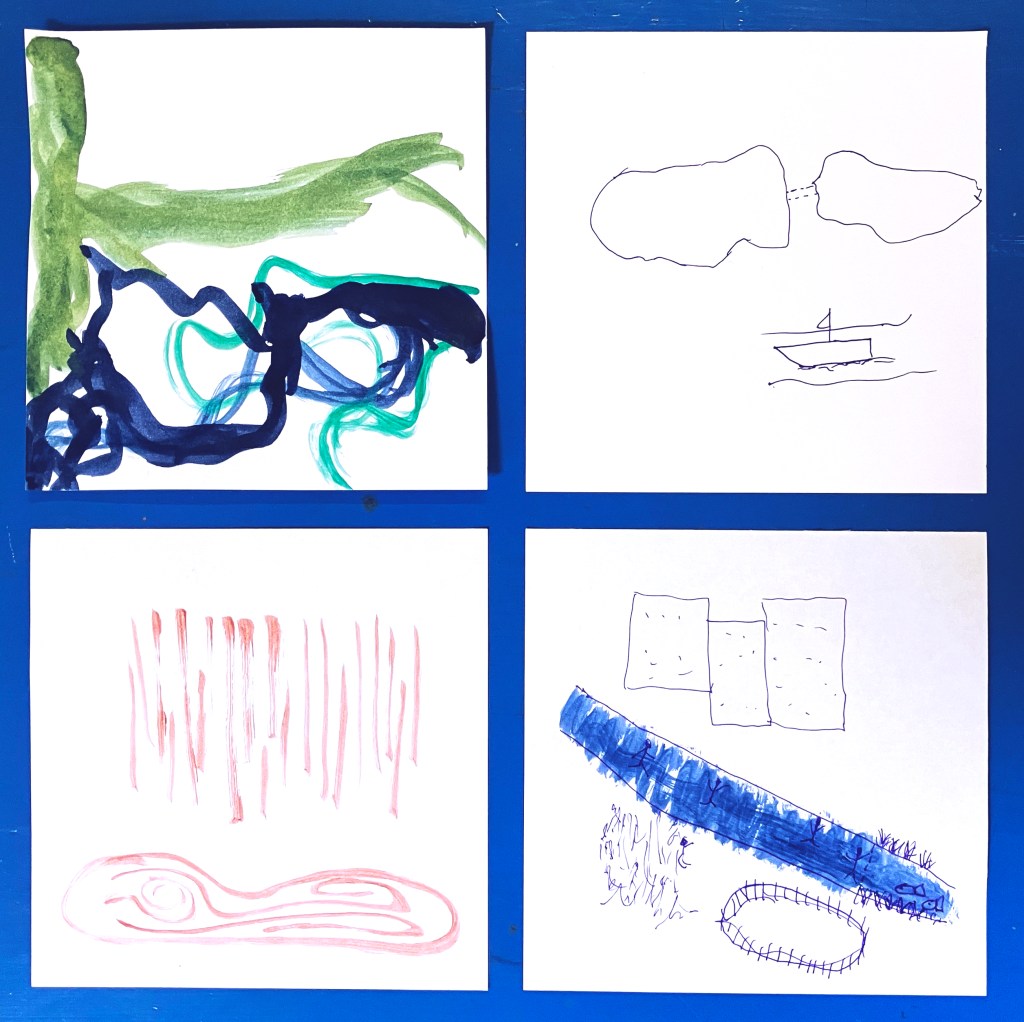
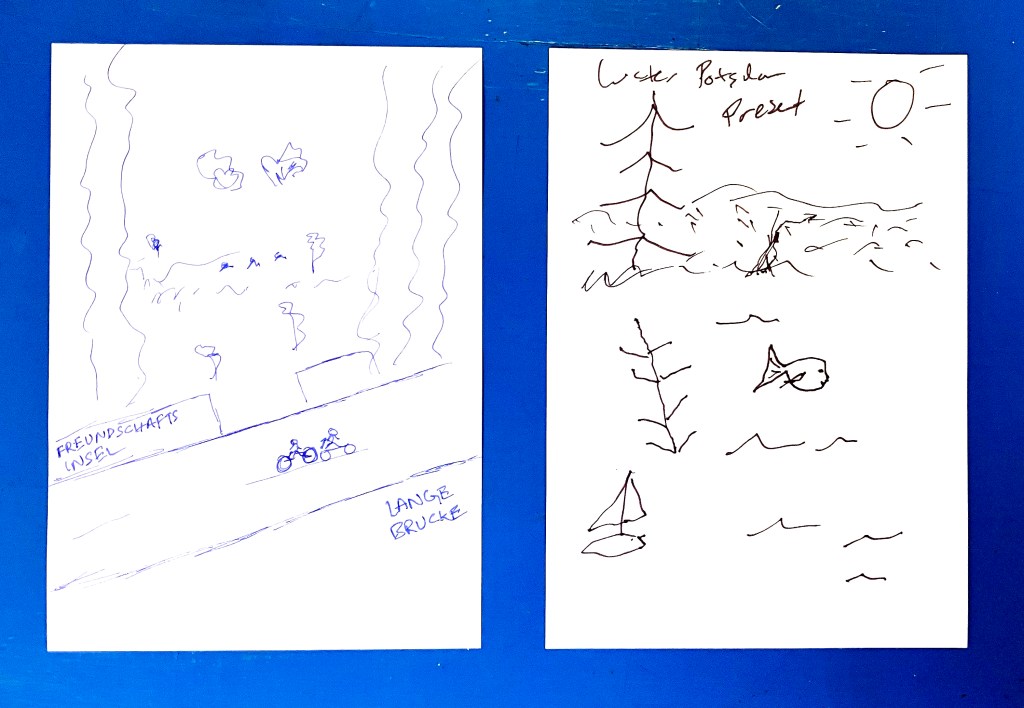
Images above: a selection of the pictures created in response to the first prompt.
Then we moved on to the second set of pictures, about the future of freshwater Berlin / Potsdam:
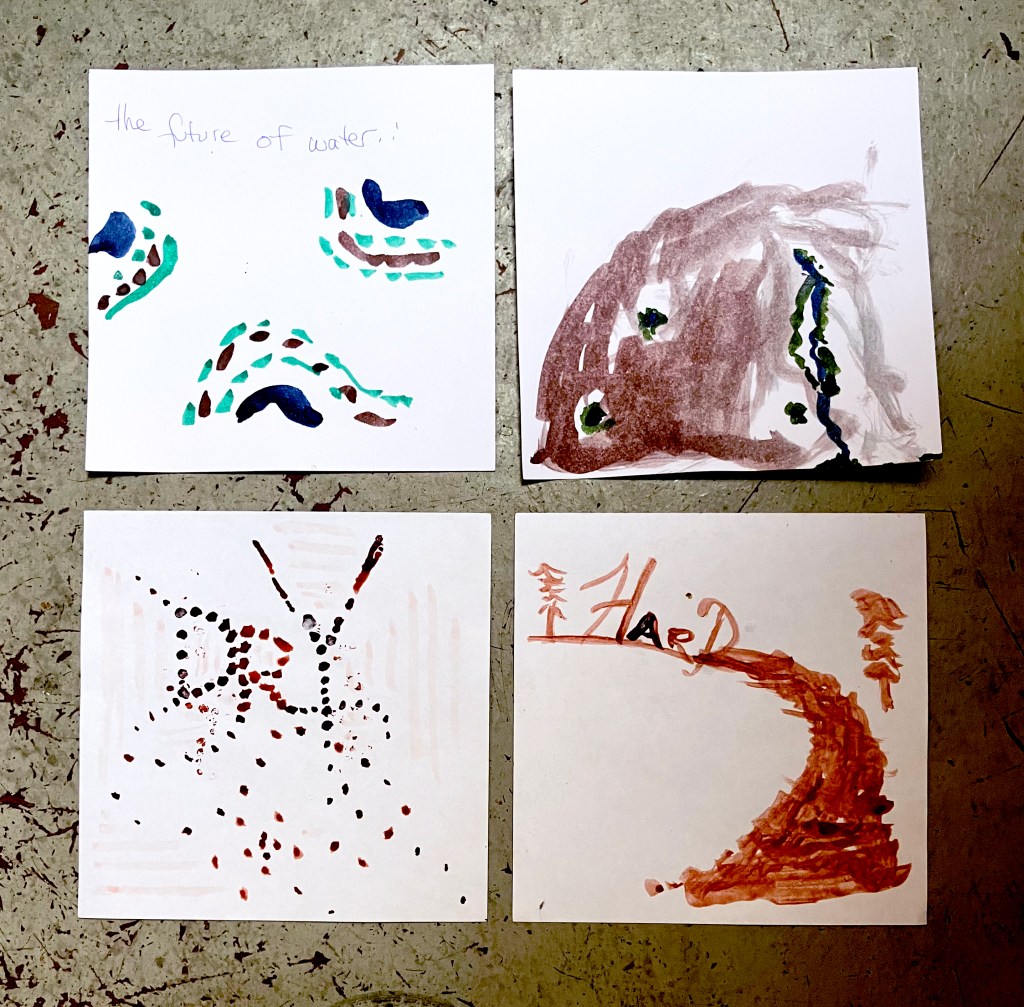
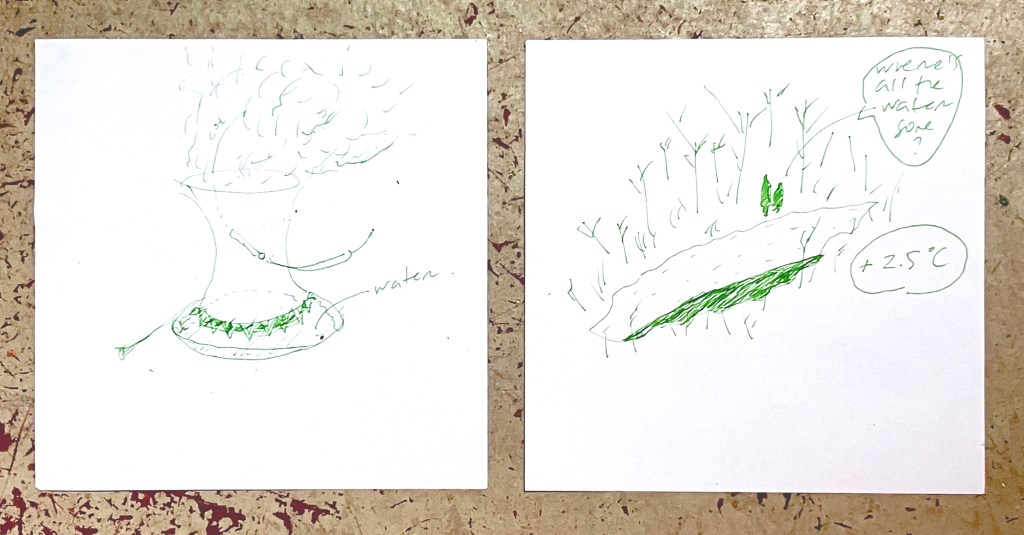
Overall – as you can see – one big difference was glaringly clear: there is a sense that there is plenty of water now, but water scarcity in the future.
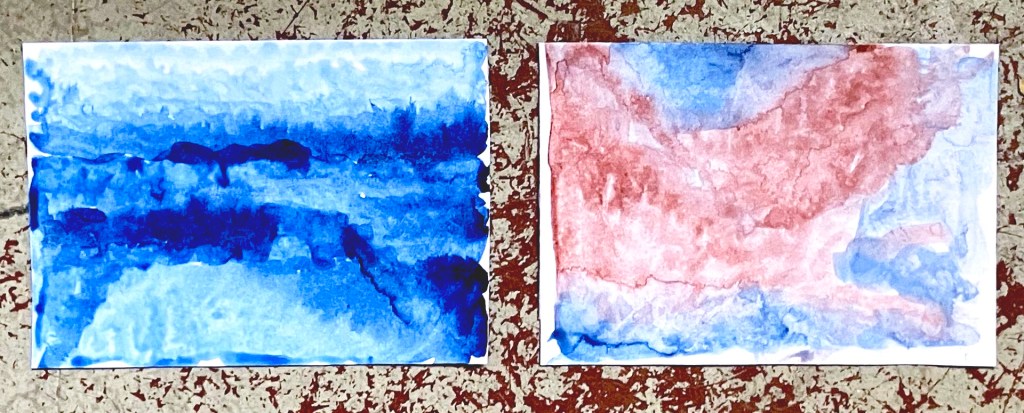
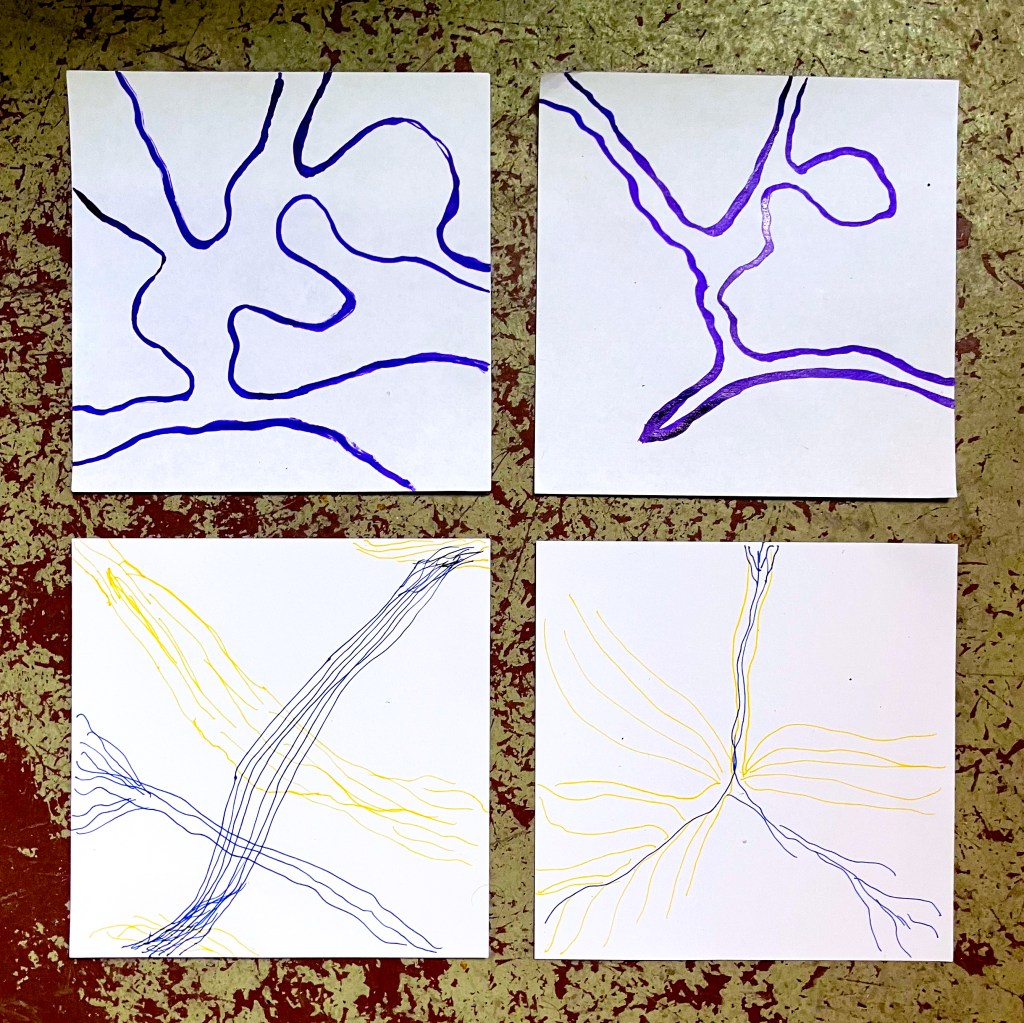
Images: pictures created showing ideas about the present (L) and future (R) of water, side by side.
While they were talking, I wrote keywords (concepts) on the whiteboard, using a different colour for each of the two prompts. I started to map connections between concepts, represented by a connecting line. After the picture discussion, we moved on to talk about the words on the whiteboard. The group made further connections between them.
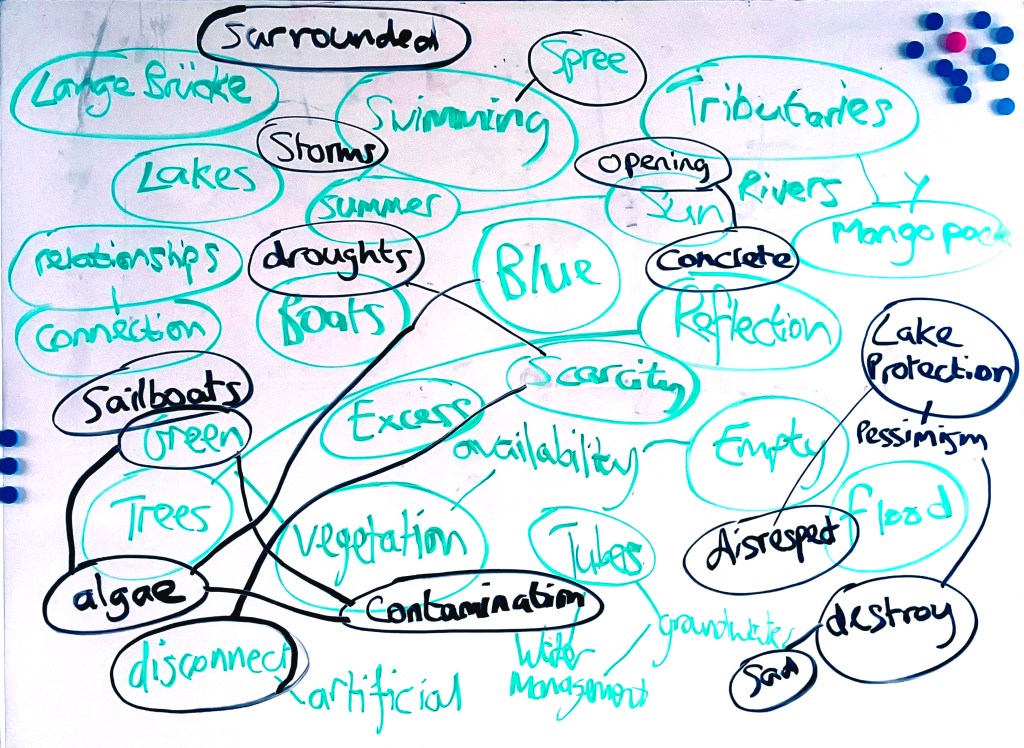
Keywords relating to the current water situation were generally positive, if mixed, while the keywords relating to the future were notably more pessimistic. While there were a few animals represented in the pictures of water now (fish and birds), they did not feature in future water. Animals were not mentioned in the discussion of the pictures (keywords), although vegetation featured strongly (“vegetation”, “trees” and “algae”).
Presentation
I then talked a little about my visual research – so far an exploratory collection of three sets of images held together by a loose narrative or series of associations. The three sets of images correspond to the three research areas I am investigating: freshwater in Berlin, freshwater in Minoan (Bronze Age) Crete and freshwater mussels.
(1) Berlin: a partial visual ethnography of water in contemporary Berlin, comprising my own photographs of bodies of water in Berlin and images from the German Water Framework Directive.
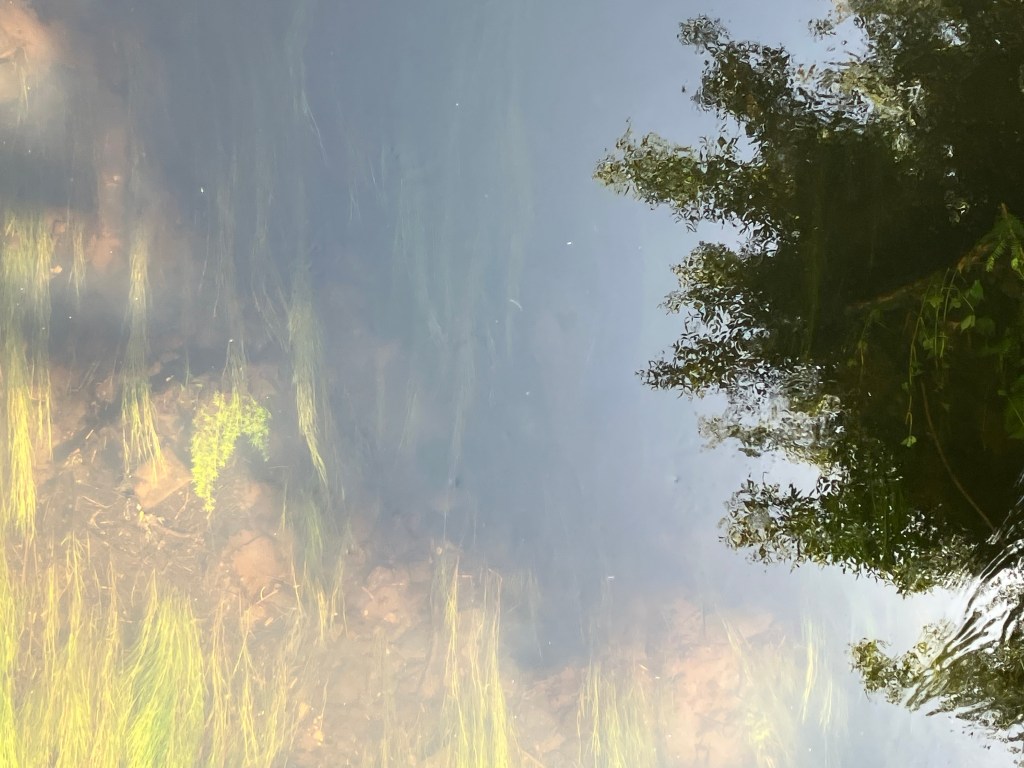
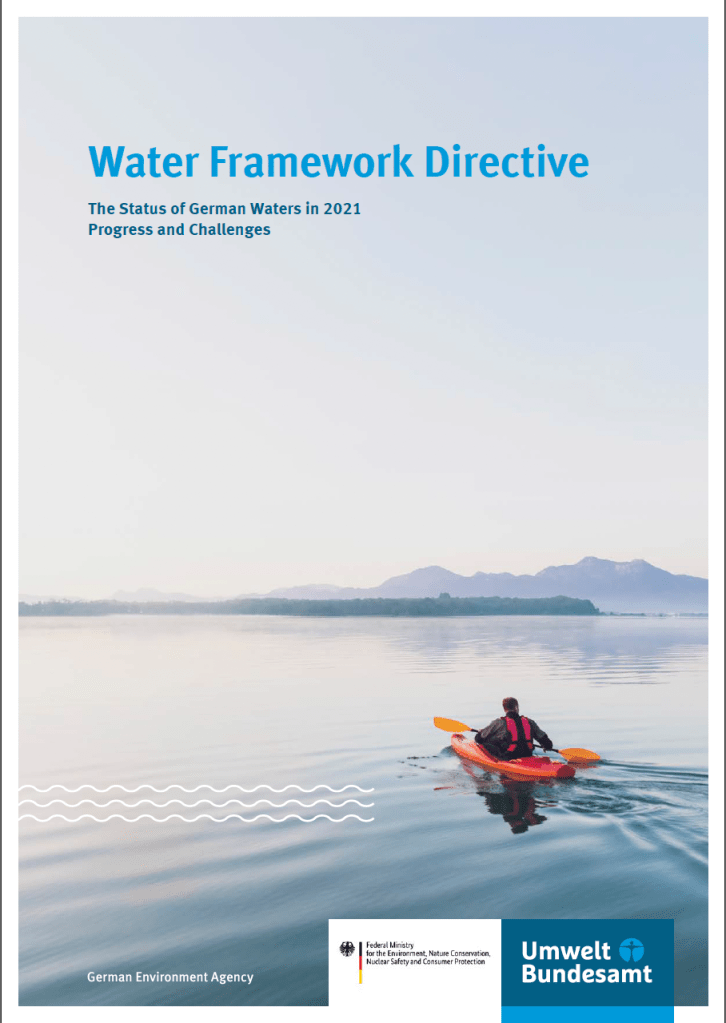
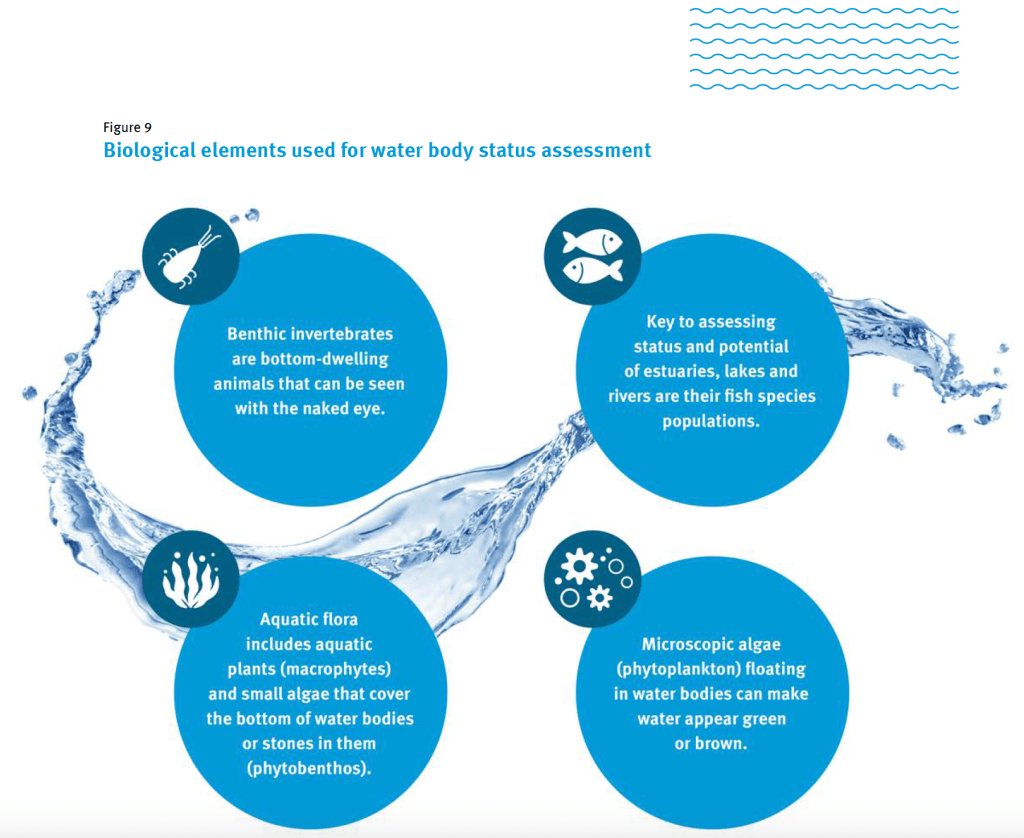
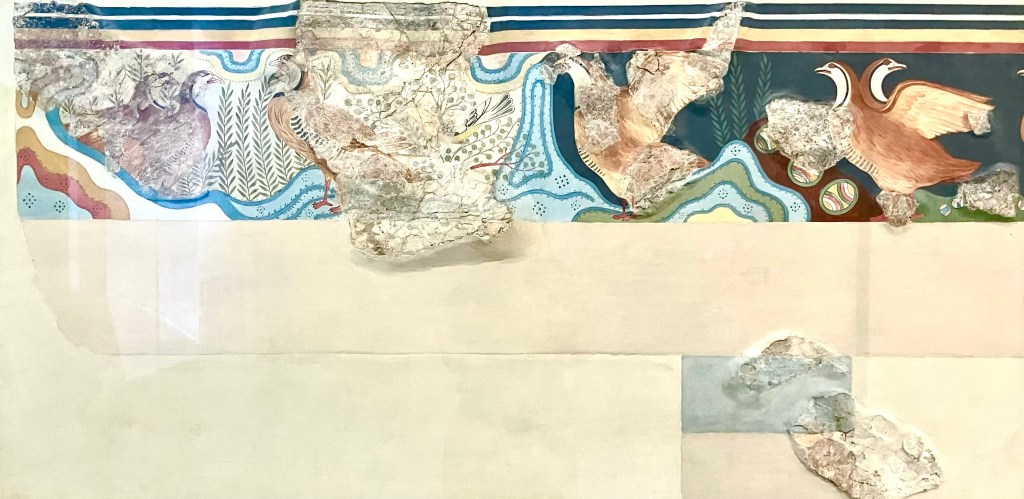
(2) Minoan Crete: images of freshwater and riverine scenes, from Minoan frescoes, seals and other visual artefacts, including images of water dragons; images of Cretan freshwater thought to have been used in (social / religious) rituals, including sacred caves and frescoes. I also included two images from later Ancient Greece, one showing a water nymph – guardian and protector of freshwater sites – and one of the Hydra at Lerna, a chimerical water dragon [drakon] that was part giant squid (in some representations).
Minoan visual representation works through synthetic pictorialism – that is, meaning is derived from groups of motifs rather than individual symbols. A key feature of Minoan riverine landscapes is that they are represented by groups of specific water-related flora and fauna, including mythical animals (griffins and dragons). Minoan goddess figures are also often associated with water; the sacred cave of Eileithyia pictured below has water collected in its hollows and stalagmites in the shape of female figures.
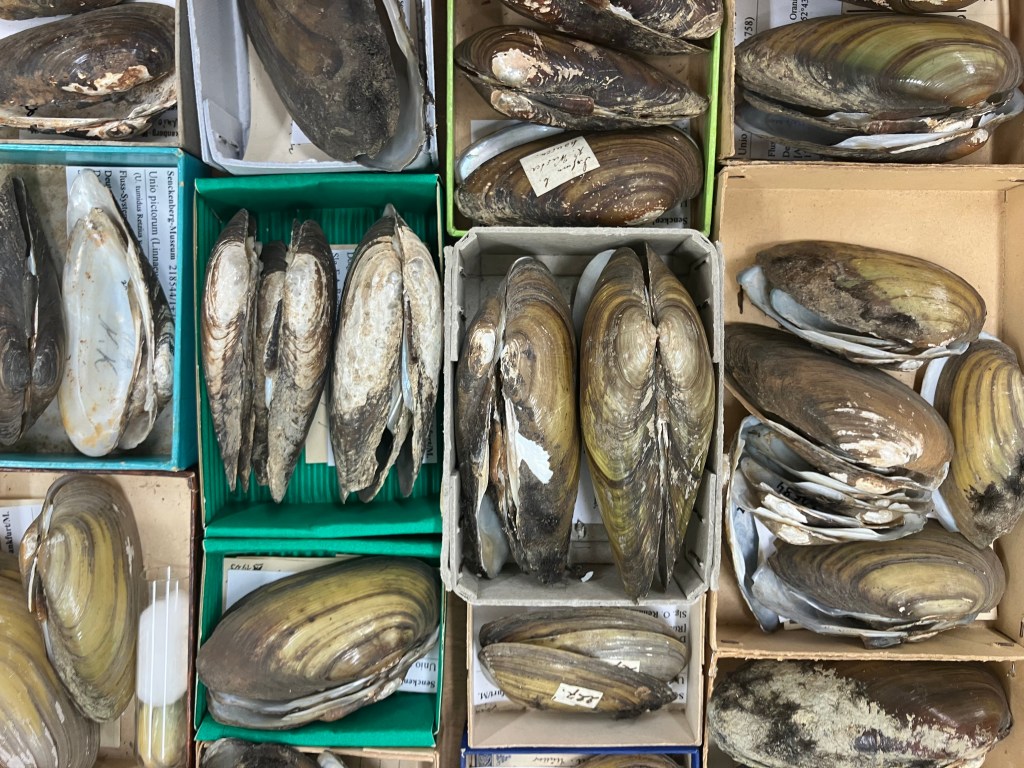
(3) Freshwater mussels: mussels from Berlin and Brandenburg, largely comprising photographs of mussel shells in the Senckenburg Museum collection, plus an image of the invasive species, the Quagga mussel, found online.
The invasive Quagga mussel seems to dominate current popular debates about mussels in Berlin freshwater (based on my conversation with members of a freshwater NGO and initial desk research) turning mussels into monsters of the deep, or at least freshwater invaders and – in the case of this article in the Tagesspiegel – climate criminals.
I constructed a narrative connecting this monster metaphor with the Minoan water dragons [drakontes] and the later villification (or monster-fication) of water dragons such as the Hydra in Greek myth. There is a further, if tenuous, connection in that the squid belongs to the same phylum as the mussel – they are both kinds of mollusc and therefore related.
Key Questions and Reflections
A set of key questions emerged from the post-workshop and -presentation discussion:
- Why are there so few animals in the group’s freshwater imaginary?
- What is the methodology for comparing the workshop images and the other sets of images?
- Why do there seem to be more projects protecting and rewilding mussels in the UK than in Germany?
- Are invasive mussels all bad / what’s bad about them?
- Can you eat the Quagga mussel?
These questions will form the basis of further research (and will be expanded on in further blog posts).
My initial question was, what can we learn from Minoan Crete and freshwater mussels for contemporary freshwater infrastructures and practices in Berlin? My reflection after the workshop was that I was perhaps trying too hard with the mussel-dragon metaphoric-symbolic connections, which are a little obscure, although may still be a part of the narrative for the artworks I intend to make (paintings and a series of postcards). The most straightforward lesson learned from comparing the workshop images and the images from the German Water Framework Directive with Minoan imagery is the apparent lack of representation of water animals and animal diversity in the contemporary German freshwater imaginary.
Given the large number of freshwater art-science projects looking at riverine hydrology, microbial ecosystems and vegetation, it seems that the most interesting contribution I can make is to focus on mussels in freshwater ecosystems. My current focus therefore is to explore the question, what if water policy was written from a mussel’s perspective, or centred mussels’ needs – what difference might that make?
While the Minoan comparison is interesting and its imagery is rich, a more fruitful comparator for thinking about water policy might be with the UK, where freshwater mussels seem to have a higher and more positive profile and far more conservation projects. Is it true that there are more freshwater mussel conservation projects in the UK? If so, why is this the case?
Conceptual Underpinning
The workshop was framed around the idea of imaginaries, in the sense of social and socio-technical imaginaries. This is a concept from science and technology studies, anthropology, sociology and philosophy (and distinct from the psychoanalytic concept), referring to the set of values, institutions, laws, and symbols through which people imagine their social whole (Marcus, 1995).
The widely cited definition by Jasanoff and Kim emphasises the concept’s future orientation – essentially, a top-down consensus about societal futures. In the most recent version (updated in their 2015 book), this socio-technical imaginary is defined as:
“collectively held, institutionally stabilised, and publicly performed visions of desirable futures… animated by shared understandings of forms of social life and social order attainable through, and supportive of, advances in science and technology.” (Sheila Jasanoff and Sang-Hyun Kim, 2015, p33)
Key institutions they list are legislatures, courts and the media. They include other collective institutions, such as corporations, social movements, and professional societies; they make transtemporal and translocal comparisons, across political regimes and histories.
I am specifically interested in ecological imaginaries here. There is a plethora of sustainability-focused papers that use the concept of imaginaries, particularly in the field of energy and social science (Hendriks et al., 2025, pp. 5-6). The alternative term socio-environmental imaginaries has been coined by Francesc Rodriguez, based on his work with riverine communities in Costa Rica (Rodriguez, 2023). Rodriguez draws on a number of pre-existing definitions of the imaginary to develop this concept in ways that foreground desires for the future based on people’s lived experience in environments over techno-scientific progress and solutions. Rodriguez’ study compares ways the socio-environmental imaginary is produced top-down by the law / regulations and policy with the bottom-up imaginary co-created by local communities through shared experiences of living-with and in rural environments. Visual analysis is a significant part of his method, where he compares images about the proposed dam project created by the communities with those produced and disseminated by the hydroelectric companies. His visual methods inspired my approach to the workshops.
The whiteboard concept map and prompts were inspired by my experience of co-creating ontology models and carrying out qualitative, semi-structured interviews while at Etic Lab [link]. Ontology modelling comes out of information science, and aims to identify and categorise entities existing within a specific domain. Qualitative interviews provide contextualisation for the research from multiple perspectives. Here, the domain is this particular group’s imaginary of freshwater in Berlin and Brandenburg, with the group representing a sustainability focused professional research perspective.
Future Workshops
In future, in longer workshops, I plan to expand the exercises here. This workshop had a necessarily restricted timeframe – given more time, it would be beneficial to spend longer on each part of the discussion and to expand the discussion. In particular, to carry out an initial visual analysis together; to spend longer discussing the connections between the keywords; and then to collectively develop and refine the concept map.
The collective visually analysis work will focus on comparing imagery, motifs, forms, metaphors, perspectives and colour; the concept mapping exercise will contextualise and enhance the visual analysis.
To properly develop a concept map of the domain, we would seek to collectively define each concept within the domain – including deciding on which words relate to key concepts and which are instances of the key concepts. We would then decide on the most important relations or dynamics between these concepts. This would enhance the co-creative aspect, offering a richer, more consensual model of the group’s imaginary.
References
Jasanoff, S., & Kim, S. H. (Eds.). (2019). Dreamscapes of modernity: Sociotechnical imaginaries and the fabrication of power. University of Chicago Press.
Hendriks, A., Karhunmaa, K., & Delvenne, P. (2025). Shaping the future: A conceptual review of sociotechnical imaginaries. Futures, 103607.
Houseman, L. (2014). Fluid Metaphors: Exploring the Management, meaning and perception of Fresh water in Minoan Crete. (PhD thesis.) The University of Manchester (United Kingdom).
Friedrich, J., & Hendriks, A. (2024). Imagined futures in sustainability transitions: Towards diverse future-making. Futures, 164, 103502.
Marcus, G. E. (Ed.). (1995). Technoscientific imaginaries: Conversations, profiles, and memoirs (Vol. 2). University of Chicago Press.
Peatfield, A. (1995). Water, fertility, and purification in Minoan religion. Bulletin of the Institute of Classical Studies. Supplement, 217-227.
Pearce, A. L. (2017). Fresh Water Scenes in Minoan Art. (PhD thesis.) Temple University.
Rodriguez (Contested Socio-Environmental Imaginaries of Water and Rivers in Times of Hydropower Expansion in Costa Rica
 Mollusc Realism
Leave a comment