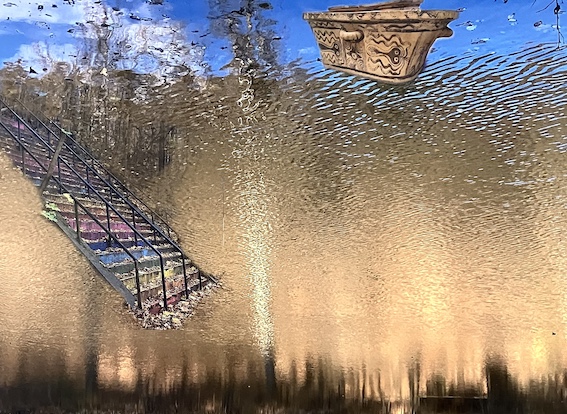
This post began as a talk I gave at the second Therapeutic Landscapes conference in Worcester earlier this year (about which, more at the end of this post). The talk was in turn based on a postdoctoral fellowship I undertook in the Faculty of Fine Art at Brno University of Technology, Czechia, in 2024-5, with a project titled: ‘The Solar Goddess:Investigating Ecological Metaphors in Image and Ritual through Minoan Crete and Twentieth Century Painting’. The support and input of the lecturers in Studio 3 Painting, Patricie Fexová and Veronika Vhlká, was invaluable. So was my meeting with archaeologist Věra Klontza-Jaklová of Masaryk University in Brno, who shared her knowledge with great generosity and shaped my research profoundly. Having an archaeologist’s perspective on the project was a real gift (while any errors are entirely my own).
An Ecological Problem of Representation
The ‘Solar Goddess’ project addressed the ecological problem of representation for better connecting with the natural world, in the context of climate change and the technicised visuality of computer-generated imagery (Crary 1992), technical images (Flusser 2006), and computer vision AI. The question of how we see in relation to our physical, psychological and metaphysical understanding of the world has been explored by psychologists, art historians, and artists (Gibson 1979; Gombrich 2000; Panofsky 1997), with the early modernist Impressionists notably questioning the nature of light and opticality, painting outdoors, and attempting to simulate the optical effects of sunlight on their perceptions of the environment through diverse techniques and formal innovation in paint (Callen 1983). The ‘Minoans’ – as the inhabitants of Bronze Age Crete have been called – whose beliefs we know about largely from surviving visual and material cultural artefacts, appear to have had a wide range of symbols, beliefs and rituals relating to the sun (Goodison 2001; Ridderstad 2009) including, perhaps, a solar goddess (Marinatos 2010).
The project drew on recent research into cognitive embodied reception, sensory experience and somatic empathy in cultural artefacts and religious practice, across literature, ecological psychology and archaeology (Benson 2015; Caracciolo 2017; Caracciolo and Kukkonen 2021; Hamilakis 2013). And it also set Crete alongside Central Europe, specifically contemporary Brno, in a translocal-transhistorical twinning. I explore both of these aspects further in the next two posts, which focus on:
(1) The temple-palace site at Knossos as a solar circuit and early urban prototype with an ecological, cyclical orientation, layout, and décor that connect sky, earth and sea; its architecture semantically activated by visual imagery, controlled plays of sunlight (and dark), and performed actions. This is the subject of the next post.
(2) Minoan solar marine cosmological ecology (and what this all has to do with molluscs), which will be reviewed in the third post.
In this post, I investigate the Minoan ecological symbolic (or semiotic) system’s sophisticated interplay of visual and semantic correspondences relating to the sun.
Metaphor and Metaphysics: A Different Mindset
Before getting into the solar symbolism, a note on metaphor and metaphysics. The project originally set out to investigate Minoan ecological and metaphysical metaphors for the sun. This was my first, very elementary, mistaken assumption. I later learned from Věra what I should already have understood, in a different context, from Panofsky: that the Minoans had a very different mindset to our contemporary one.
Panofsky’s ‘perspective as symbolic form’ is the idea that spatial representation in painting compresses social, cognitive and psychological practices, which are ordered and translated through a technique. Linear perspective, for Panofsky, represents “a translation of psychophysiological space into mathematical space,” thus objectifying what was previously subjective (Panofsky 1997, p.66). It both reflects and produces a shift in mindset and perception, in the way we think we see the world. Pre-modern viewers would not have taken a linear perspective painting to be a representation of the way we ‘really’ see: different epochs entertained different perceptions of the world. Panofsky describes linear perspectival construction as a “systematic abstraction from psychophysiological space” that is alien to direct experience (ibid., p.30). (For a tortured exploration of the implications of Panofskyan perspective and Flusserian technical images, see my speculative essay on ‘Alien Perspective’: Moran 2019, pp.30–44.)
This idea is updated for the twenty first century by artist Hito Steyerl, who shows how contemporary imagery has acquired an additional dimension that she calls “vertical perspective”: the bird’s or god’s -eye view that is techno-culturally constructed through digital forms such as 3-D cinema, surveillance, and Google maps (Steyerl 2012) – and now ever more prevalent from drone cameras, whether grainy military news report footage or a current feature film trope of lush opening fly-over shots.
Panofsky’s position is not far from J.J. Gibson’s assessment of linear perspective painting as lacking correlation with natural vision, although Gibson (and Gombrich, for different reasons) criticised his apparent alignment with the idea of visual perception being curved in the perspective of pre-Modern art (Alloa 2015, p52). Gibson critiques linear perspective as a monocular, frozen flattening of visual perception which does not correspond to ecological perception, where vision is binocular (for humans), constantly moving, and part of the wider sensory system (Gibson 1979). Panofsky’s reading of pre-Modern perspective is that the ancients had no conception of systematic space (the space between objects, in artworks): they had no “coordinate system”, their space being qualitative rather than quantifiable, as in Aristotle’s up, down, front, back, left and right (Panofsky 1997, pp.41–44). Regardless of the correctness of his reading, Panofsky significantly shows how perspective in visual representation is a cultural construct.
There has been a similar shift in symbolic comprehension, to the extent that our idea of metaphor was not a concept the Minoans would likely have recognised. Archaeologist Jan Bouzek suggested the Minoan mindset was a mythic one, in which all of nature may be understood as divine or sacred (see Bouzek 2018 on the transition from the Bronze Age to Ancient Greece, from myth to logos). In their comprehension, correspondences were not metaphorical but symbolic: Minoan representations of Cretan nature, such as plants, animals and particular landscapes, as well as non-local and mythical entities, were selected for their attributes. As Marinatos puts it, “selection is related to the specific properties that the animals or plants were thought to possess” (Marinatos 1993, pp.194–5). For a project concerned with how images might reconnect us with the natural world, this was a crucial correction. The question was no longer which metaphors the Minoans used for the sun, but how symbols function within a mythic mindset.
Reading a Culture Through Its Images
Little useful written material has been found about Minoan religious or cultural practices. The surviving texts, in Linear A and Linear B, are largely administrative records. Solarity and celestial events in Minoan religion and ritual are therefore interpreted largely through the material and visual culture the Minoans left behind: frescoes, objects and architecture.
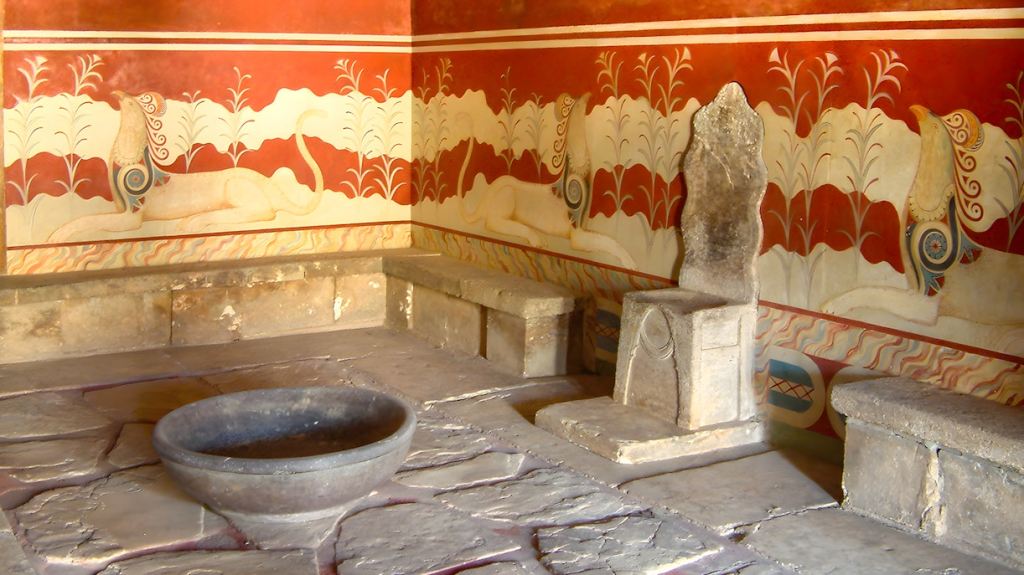
Fortunately, Minoan culture was highly visual. It left a rich array of artefacts with a sophisticated range of solar symbolism, which appears to have had an ecological interconnectedness, bringing together sky, land and sea. Griffins, for example, were mythical creatures with the body of a lion and the head of an eagle that represented the sun and are symbolically connected to the solar goddess, often being shown in pairs (Marinatos 2010). At the Knossos site, a pair of griffins are depicted beside a stream, flanking the throne in the Throne Room (image above). Marinatos suggests they were superior to natural predators, and as such were attendants and guardians of the gods (Marinatos 1993, p.197).
A Symbolic Vocabulary of the Sun
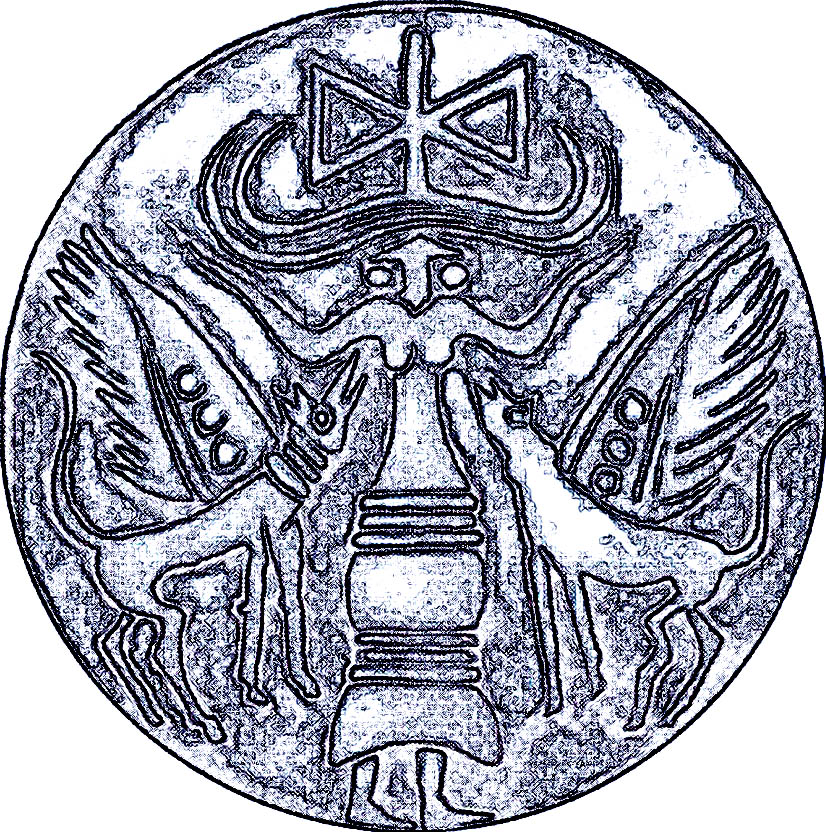
Archaeologist Nanno Marinatos (2010) argues that Minoan Crete had a whole symbolic vocabulary for the different phases of the sun and its significance. She describes “a large and complex [Minoan] pictorial dictionary” that “revolved around the sun”, consisting of “an entire system of interconnected concepts” linked through their form and their relations to each other, and comprising “a vocabulary of sacredness” (Marinatos 2010, p.38). The Minoan pictorial vocabulary contained many celestial symbols (Ridderstad 2009), not only solar ones, although the sun is my focus here.
While Marinatos reads the solar symbols across the shared cultural ‘koine’ of the Eastern Mediterranean, Věra Klontza-Jaklová (2018) identifies common sets of symbols across the Bronze Age Eastern Mediterranean and Central and Western Europe. Spiral symbols, moon motifs and double axes are commonly found across both regions. In Europe, “the double axe is also used as an element in the composition of pendants, together with ‘moon’ and wheels, or with symbols of leaves or shields (Fig. 21)” (Klontza-Jaklová 2018, p.51). Marinatos suggests that the famous Minoan double axe signifies the sun emerging on the horizon (2010, p.129).
Horns, Mountains, and the Rising Sun
Bovine horns are common in Minoan and Egyptian symbolism. When I met Klontza-Jaklová in Brno, she pointed out that while bovine horns are in most cultures connected to male power (the bull), in Minoan society the horns could be those of a bull or a cow, so their meaning may be much more context-dependent. There is certainly a strong female connotation, which also links the shape of the horns to that of the female reproductive system (the uterus).
Both Marinatos and Klontza-Jaklová read a connection, via Central European and Egyptian comparisons, between some of the horn symbols and symbols of the sun rising between mountains. Marinatos compares these to the Egyptian cosmic mountain symbol, a gate through which the rising sun passes (2010, p.107). Drawing on Egyptian and Minoan symbolism, Klontza-Jaklová suggests that the bovine “horns, combined with the sun symbol, are symbols of passing between the real world and underworld and are connected with a female phenomenon as the birth-giver” (2018, p.53). More broadly, she suggests that these symbols are all “connected with cycles in time; movement in time, life and death, rebirth, eternity” (2018, p.56).
The Solar Goddess
The solar goddess is so named for her solar symbolism. Her imagery gathers the double axe, the bovine horns and pairs of griffins, all of which also stand for the sun. Celestial rituals of light and dark at Knossos may have been presided over by a Minoan solar or astral goddess, or a goddess presenting those aspects, who ruled the earthly daylight lands and the sunlit underwater afterlife. Representing the cyclicality of days, seasons, death and rebirth, light and dark, she was a precursor to Demeter and Persephone, mother and daughter of seasons and harvest in Greek myth.
Painting the Correspondences
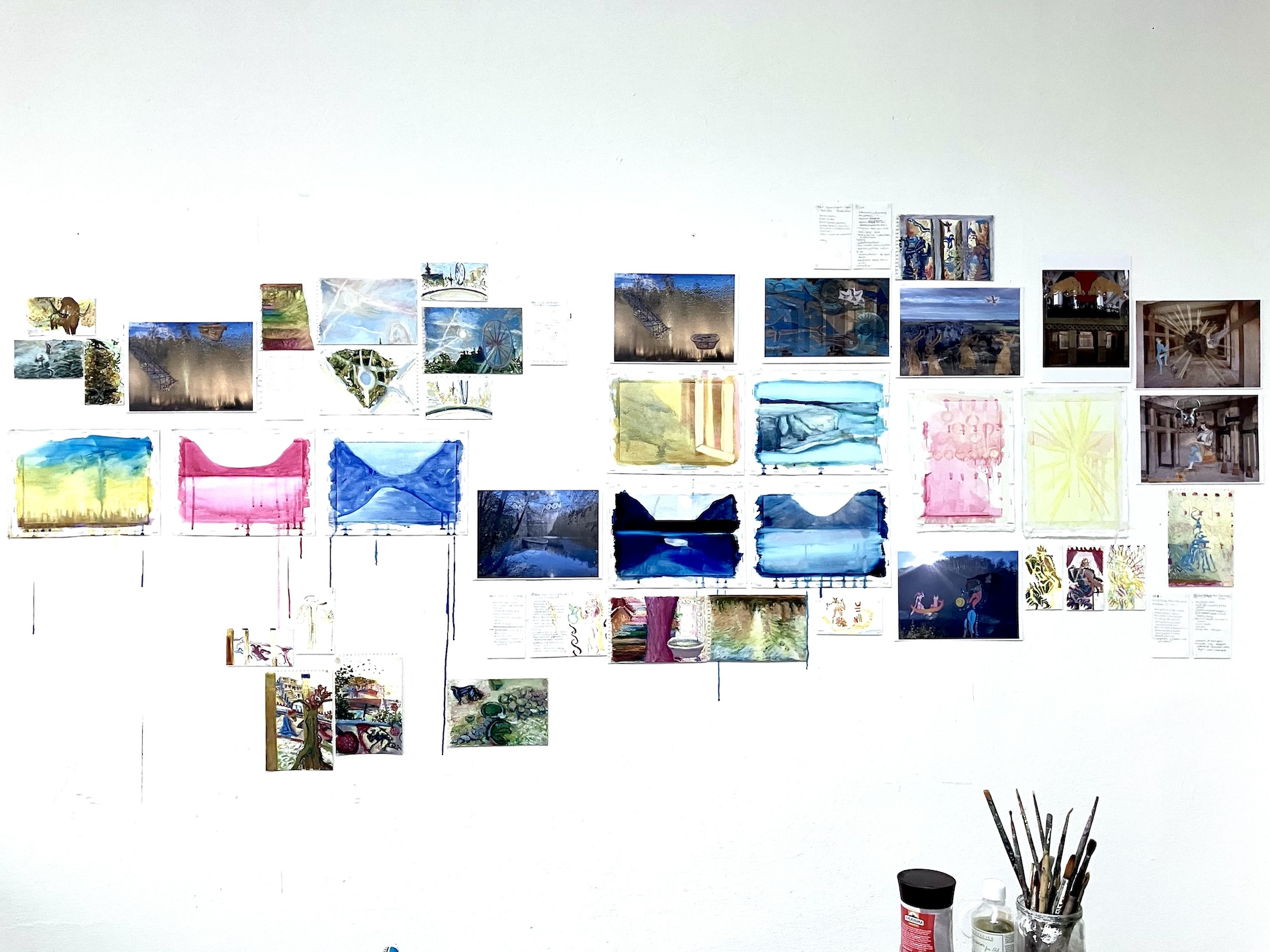
I focused on natural and cultural forms, and on the effects of light and darkness in the natural environment. Following Klontza-Jaklová’s translocal study, I also looked for symbolic, semantic and visual correspondences across the urban, cultural and natural environments of Crete and contemporary Brno.
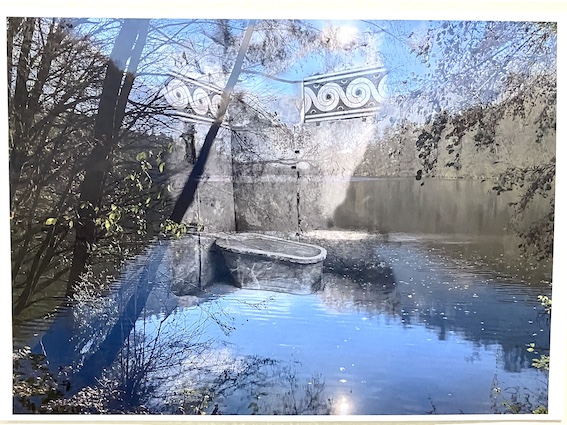
I was interested in what continuities and transmutations may exist, visually, spatially, and ecologically. I began with plein air sketches, and blended spaces and forms through digital collage. I also experimented with relating these interconnected visual concepts to natural phenomena and environments: the conjunction of sun, mountains and water, for example, produces both double axe shapes and horn shapes.
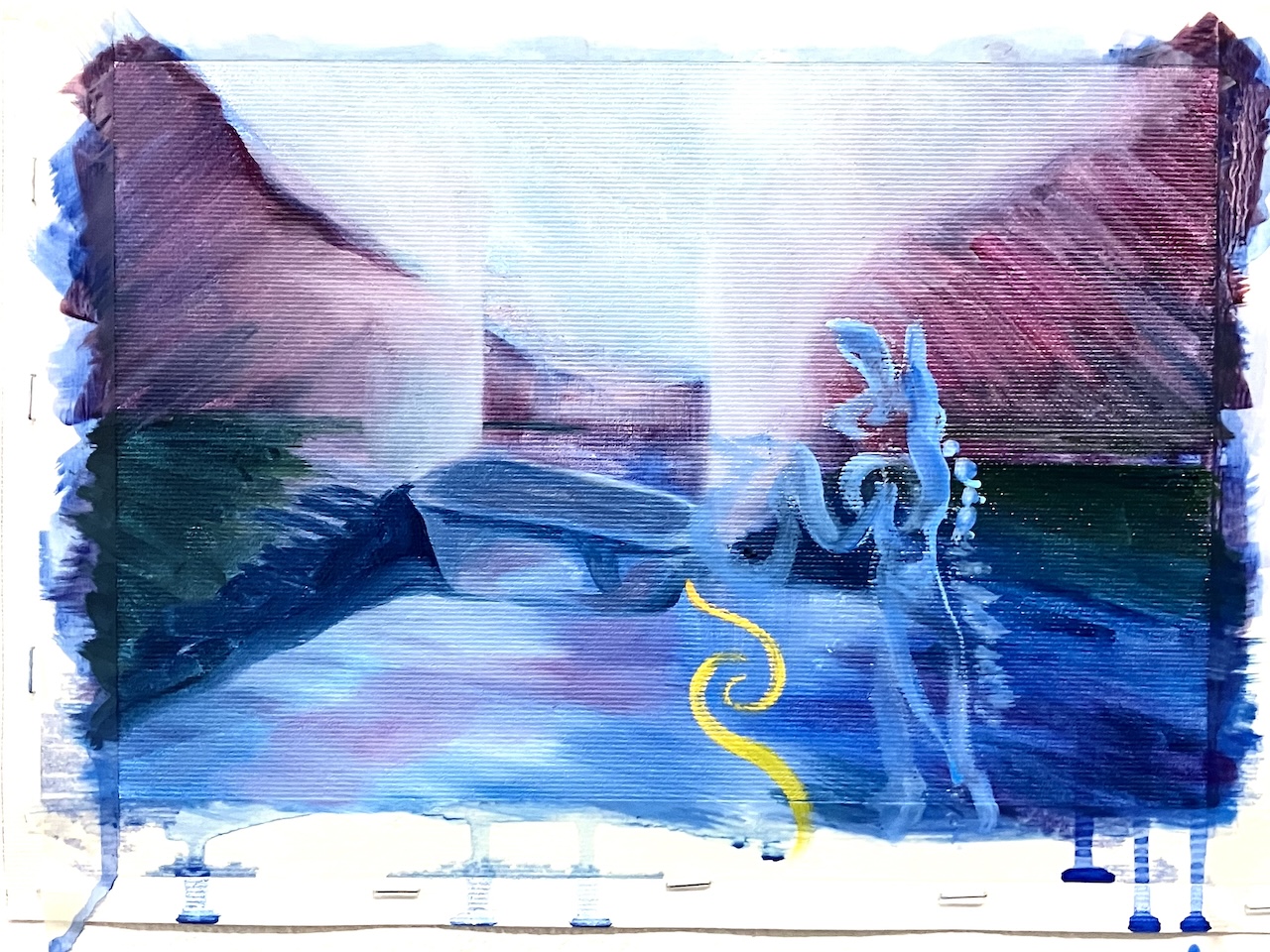
The works in progress and studies shown here are experiments with corresponding forms, such as bovine horns, mountain peaks, double axes, boats and larnakes (coffins), that are also solar symbols connecting a range of Minoan cultural activities and forms, including agriculture, sailing, religious practice and cosmology. They include studies of corresponding locations in and around Brno, on which more in the next post.
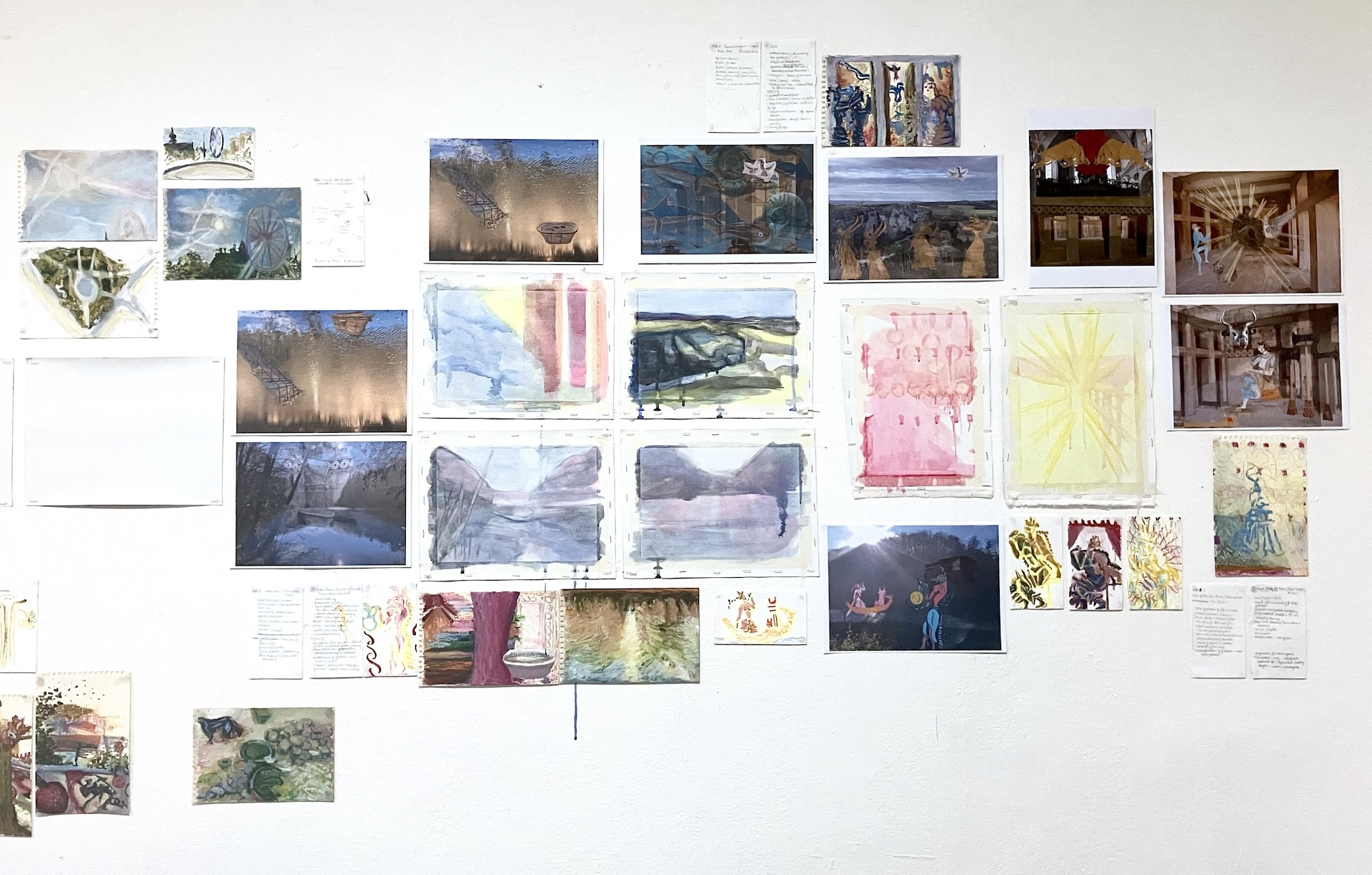
The next post will discuss the first body of paintings I made after these sketches, which attempt to reconcile these correspondences through visual and spatial connection across the two natural and cultural environments, translocally and transhistorically.
Postscript: Towards a Rural Cosmopolis
This project laid the groundwork for my concept of the Rural Cosmopolis and cosmopolitan ruralism, which I took up as the theme of my next fellowship, at RIFS. What began as a question about representation here became a question about the urban imaginary, deploying a working definition of “an imaginary for creatively adaptive post-growth urban eco-cultures”. Most basically, the Rural Cosmopolis is the idea of an urban culture and built environment that intentionally integrates and references natural environments and cycles in its layout, visual culture, and rituals. It learns from local ecological knowledge and ‘rural’ practices, including artistic and artisanal ones, while maintaining a cosmopolitan outlook (drawing on both Rosi Braidotti’s reconception of cosmopolitanism as an “ethical-political relational model of planetary interaction” (Braidotti 2013), revisiting Isabel Stengers’ cosmopolitics (Stengers 2010) through a new materialist lens (Barad 2007, 2012, 2014; Bennett 2020), and anticipating David Burrows’ forthcoming book on cosmopolitics and art, to consider a multispecies cosmopolitanism and). Conversely, it also means the integration of cosmopolitanism in rural environments and practices. This included discovering, repurposing and reimagining concepts and processes for the resilient, creative and adaptive practices of future (sustainable, smart) cities.
I found many examples of this in the artistic and rural practices presented at Therapeutic Landscapes 2026, including Rima Staines’ deep engagement with the South Devon environment through storytelling and painting; Bettina Borg Cardona’s research on rituals of music and dance as ‘holistic’ healing practices at the ancient Greek sanctuary of Epidauros; and Kate Walters’ dream paintings that address the soul of things. Examples of participatory rural cosmopolitan practices included the range of community, heritage and land-based creative health initiatives in rural Herefordshire discussed by keynote Joanna Latimer; Rosie May Jones’ community pageant project developing connections between isolated communities and the Surrey landscape; the diasporic placemaking practices María Verónica Laguna’s talk drew attention to; and Marie Hvozdecká’s Folklor & City project in Brno. I continue to flesh out the concept, through situated rural and urban practices, art, and ecofeminist science fiction; attempting to consider its implications for cognitive (enactivist) literary theory and ecological narratives. More to follow.
References
Alloa, E. (2015). ‘Could Perspective Ever be a Symbolic Form? Revisiting Panofsky with Cassirer’. Journal of Aesthetics and Phenomenology, 2(1), 51–71. https://doi.org/10.1080/20539320.2015.11428459
Barad, K. (2007). Meeting the Universe Halfway. Quantum Physics and the Entanglement of Matter and Meaning. Durham – London: Duke University Press.
- (2012). ‘On Touching—The Inhuman That Therefore I Am.’ Differences 23, 3, pp. 206-223.
- (2014). ‘Invertebrate Visions: Diffractions of the Brittlestar’, In The Multispecies Salon, Eben Kirksey.
Bennett, J. (2020). Vibrant matter: A political ecology of things. Durham, US: Duke university press.
Benson, L. (2015). Arts and Religions of Haiti: How the Sun Illuminates Under Cover of Darkness. Kingston, Jamaica: Ian Randall Publishers.
Bouzek, J. (2018). Studies of Homeric Greece. Prague: Charles University, Karolinum Press.
Braidotti, R. (2012). ‘Becoming-world’. In After cosmopolitanism (pp. 8-27). Oxfordshire: Routledge.
Braidotti, R., Hanafin, P., & Blaagaard, B. (Eds.). (2013). After cosmopolitanism. Oxfordshire: Routledge.
Callen, A. (1983). Techniques of the Impressionists. London: Tiger Books International.
Caracciolo, M. (2017). The Experientiality of Narrative: An enactivist approach. Vol. 43. Walter de Gruyter GmbH & Co KG.
Caracciolo, M. and Kukkonen, K. (2021). With Bodies: Narrative Theory and Embodied Cognition. Ohio: Ohio State Press.
Crary, J. (1992). Techniques of the Observer: On Vision and Modernity in the Nineteenth Century. Cambridge, Mass. and London: MIT Press.
Flusser, V. (2006). Towards a Philosophy of Photography. London: Reaktion Books.
Gibson, J.J. (1979). The Ecological Approach to Visual Perception. Boston: Houghton Mifflin Co.
Gombrich, E.H. (2000). Art and Illusion: A Study in the Psychology of Pictorial Representation. Princeton, N.J: Princeton University Press.
Goodison, L. (1989). Death, Women and the Sun: Symbolism of Regeneration in Early Aegean Religion. London: Institute of Classical Studies.
Hamilakis, Y. (2013). Archaeology and the Senses: Human experience, memory and affect. Cambridge, UK: Cambridge University Press.
Klontza-Jaklová, V. (2018). ‘Use of Aegean Bronze Age symbols by the local elites of prehistoric Europe’. In B. Gediga, A. Grossman and W. Piotrowski (eds.), Inspiracje i funkcje sztuki, pradziejowej i wczesnośredniowiecznej, pp.39–61.
Marinatos, N. (1993). Minoan Religion: Ritual, Image, and Symbol. Columbia, South Carolina: University of South Carolina Press.
Marinatos, N. (2010). Minoan Kingship and the Solar Goddess: A Near Eastern Koine. Illinois: University of Illinois Press.
Moran, S. (2019). ‘Alien Perspective, a Speculative Weightless Sketch’. In M. Punt, H. Drayson and S. Turton (eds.), Transtechnology Research Reader 2019–2021. Plymouth, UK: Transtechnology Research at University of Plymouth. pp.30–44.
Panofsky, E. (1997). Perspective as Symbolic Form. New York: Zone Books.
Ridderstad, M. (2009). ‘Evidence of Minoan astronomy and calendrical practices’. arXiv preprint arXiv:0910.4801.
Stengers, I. (2010). Cosmopolitics (Vol. 1). Minneapolis: University of Minnesota Press.
Steyerl, H. (2012). ‘In Free Fall: a Thought Experiment on Vertical Perspective’. The Wretched of the Screen. Berlin: Sternberg Press/E-Flux Journal, pp.12-30.


Leave a Reply